
Building a Stitching Clam - the Mouth
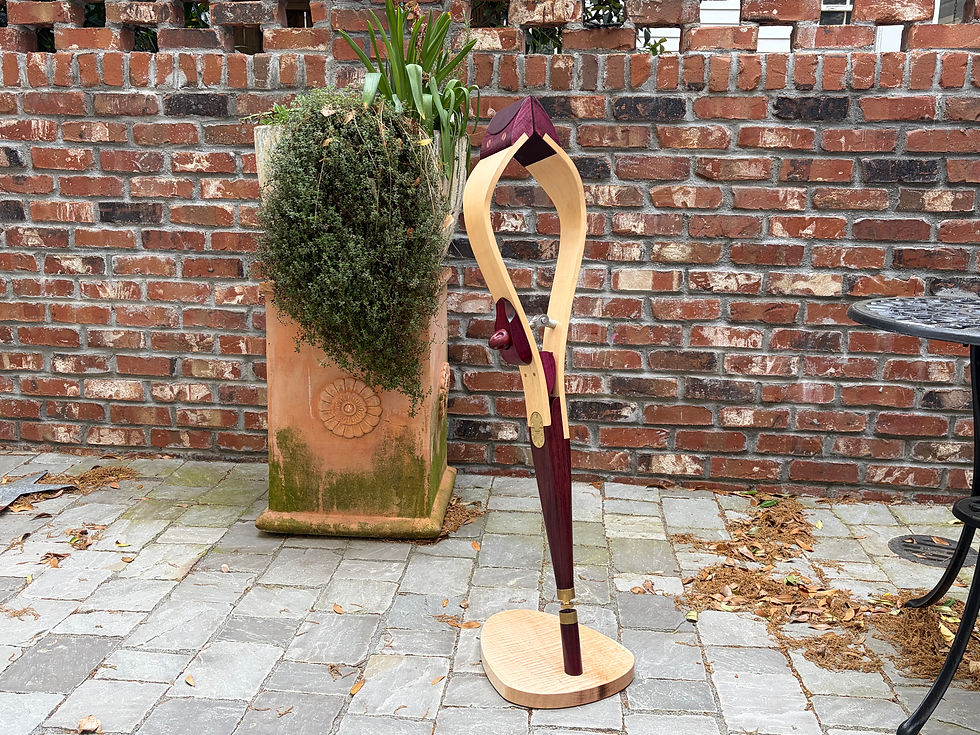
The mouth of the clam represents the component that provides the direct clamping pressure on your project piece.
Start by dimensioning two pieces that are roughly 4” x 4” x 2” to serve as the mouth of the clam. Where you want to join the mouth with the jaws of the clam you’ll need to make a rabbet cut. I typically cut this about 1/2” deep and 1.5” wide.
Cutting the Rabbet

There are a number of ways to make a rabbet cut. If you have it, a table saw with a dado stack will make short work of it, as will a router table. I have neither and instead use hand tools for this step - specifically the Veritas Skew Rabbet Plane (an absolute joy to use once you've dialed it in properly). I set the depth stop to 1/2" and then cut the rabbet in 1/2" increments. (Although this plane can cut 1.5” wide cut I found it quite hard to do on hardwood, even with a razor sharp blade. Making the cut in stages still gets me an impressively precise result with minimal effort)
Profiling the Mouth

With the rabbet cut, it’s time to cut the angle on here the mouth pieces will come together to clamp project pieces. For me this is an angle of ~49 degrees at the tip of the mouth but it will need to be calibrated to the shape of the clam. This involves laying out the jaws on a flat surface in their intended final shape and the measuring the angle they make when they come together, and then simply bisecting that angle (dividing by 2). Once you know your target angle, transfer this to your blocks using a protractor.
From here I rough cut the angled cut on my band saw and then use my belt sander (with miter gage dialed in to my target angle). The belt sander will not leave the cleanest surface, so I find it beneficial to take the time here to flatten (it will be more difficult later) using sandpaper affixed to a flat surface. It is important to achieve a nice flat surface here so that the two halves of the mouth produce a well mated surface when the clam is tensioned. Any unevenness in the surface will serve to greatly reduce the clamping pressure in the final piece.
The last step is to profile the outside of the mouth. I like to do a gentle curve from the tip of the mouth to where it joins with the jaws. Again, scribe your target profile first, rough cut the waste on the band saw, and then sneak up on your line using the belt sander. Once again, sand the surface to a smooth finish here as it will be more difficult to do so once glued to the jaws.
At this point you should be ready to join the mouth pieces to the clam jaws (which will be covered in a subsequent post)


Comments